
2006 Toyota Sequoia: Recalls, Problems & MPG
Here are the deets on the 2006 Toyota Sequoia: 8 recalls, 202 owner complaints and up to 15 mpg combined.
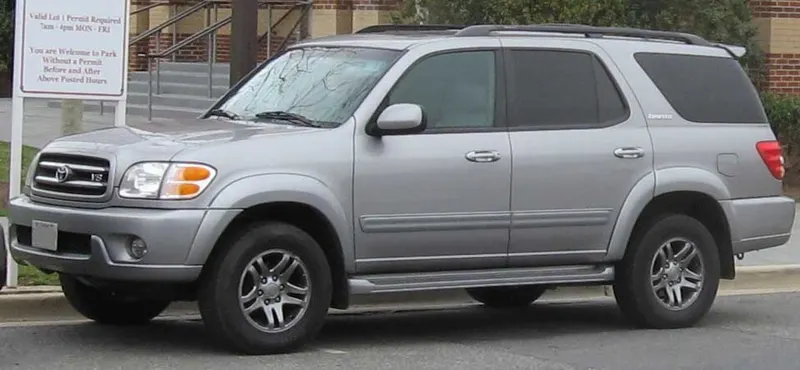

Recalls
8 vehicle recalls from the manufacturer, plus 2 equipment/tire recalls that can apply. Repairs are free. Check your VIN to see if one is still open on your car.
Suspension Vehicle recall #07V013000 · 2007 · 533,124 vehicles
What's wrong: On certain trucks and MINI vans, due to possible improper finishing of the front suspension lower ball joint, some ball joints May experience an incidental deterioration of the internal lubrication. This May cause the ball joint to wear and loosen prematurely, which could result in increased steering effort, reduced vehicle self-centering, and noise in the front suspension.
Why it matters: In extreme cases, if the vehicle is continuously operated in this condition, the lower ball joint May separate from the knuckle and could cause a loss of vehicle control.
The fix: Dealers will replace the front suspension lower ball joints. The recall began on February 28, 2007.
Equipment Vehicle recall #10V036000 · 2010 · 153,418 vehicles
What's wrong: 110, "tire selection and rims." these vehicles were sold without the requisite load carrying capacity modification labels.
Why it matters: A driver May overload a vehicle which May increase the risk of a crash.
The fix: Dealers will mail to consumers the corrected label or the customer will have the option for dealers to install the label free of charge. The safety recall began on May 27, 2010.
Seats Vehicle recall #14V743000 · 2014 · 3,233 vehicles
What's wrong: The affected vehicles May experience compression of the seat cushion which May damage the seat heater wiring.
Why it matters: Damage to the seat heater wiring could cause the wires to short, increasing the risk of the seat burning and causing personal injury to the occupant.
The fix: Set will notify owners, and dealers will disconnect the heaters with copper strand heating elements and refund the purchase price of the seat heater accessory, free of charge. The recall is expected to began in January 2015.
Airbags Vehicle recall #15V285000 · 2015 · 1,973,468 vehicles
What's wrong: On June 16, 2015, Toyota expanded the recall to include an additional 1,270,468 vehicles, including model year 2002-2003 and 2005-2007 sequoia, 2005-2006 tundra, 2003-2007 corolla, 2003-2007 corolla matrix, 2003-2007 Pontiac vibe and 2002-2007 Lexus sc vehicles. This is to address a safety defect in the passenger side frontal air bag inflator which May produce excessive internal pressure causing the inflator to…
Why it matters: In the event of a crash necessitating deployment of the passenger's frontal air bag, the inflator could rupture with metal fragments striking the vehicle occupants potentially resulting in serious injury or death.
The fix: 2003-2004 corolla and corolla matrix vehicles that are recalled under both 15v-043 and 15v-285 are under a do not drive advisory. Owners of these vehicles are advised not to drive their vehicles until the recall remedy has been completed. Toyota will notify their owners. Pontiac vibe owners will be…
Airbags Vehicle recall #15V286000 · 2015 · 1,069,055 vehicles
What's wrong: S. Virgin islands, guam, saipan and american samoa. On June 16, 2015 Toyota expanded the recall to cover an additional 769,055 vehicles, including certain model year 2002-2004 Lexus sc, Toyota sequoia, 2003-2004 Toyota corolla matrix, Toyota corolla, Pontiac vibe, and Toyota tundra vehicles, as well the vehicles covered by the May 13, 2015 notification in the portions of georgia, alabama, louisiana, mississippi and…
Why it matters: In the event of a crash necessitating deployment of the passenger's frontal air bag, the inflator could rupture with metal fragments striking the vehicle occupants potentially resulting in serious injury or death.
The fix: 2003-2004 corolla and corolla matrix vehicles that are recalled under both 15v-043 and 15v-286 are under a do not drive advisory. Owners of these vehicles are advised not to drive their vehicles until the recall remedy has been completed. Toyota will notify their owners. Pontiac vibe owners will be…
Airbags Vehicle recall #16V065000 · 2016 · 320,409 vehicles
What's wrong: The affected vehicles have an air bag control module that May be improperly programmed, causing the side curtain-shield-air bags to deploy inadvertently.
Why it matters: If the side curtain-shield-air bags deploy unexpectedly, it can increase the risk of occupant injury.
The fix: Toyota will notify owners, and dealers will replace the air bag control module with one that has improved programming, free of charge. The recall began on December 1, 2016.
Seats Vehicle recall #16V396000 · 2016 · 7,749 vehicles
What's wrong: The electrical wiring in the seat heaters May be damaged when the seat cushion is compressed.
Why it matters: If damaged, the copper strand heating element May short circuit, increasing the risk of a fire.
The fix: Set will notify owners, and dealers will disconnect the seat heaters, free of charge, and refund the purchase price of the seat heater accessory. The recall began on July 14, 2016.
Airbags, Airbags Vehicle recall #19V741000 · 2019 · 928,220 vehicles
What's wrong: These vehicles had their driver or passenger frontal air bag inflators previously replaced under a prior recall using inflators of the same design. The inflators May explode due to propellant degradation occurring after long-term exposure to high absolute humidity, temperature and temperature cycling.
Why it matters: An inflator explosion May result in sharp metal fragments striking the driver or other occupants resulting in serious injury or death.
The fix: Toyota will notify owners. Depending on the vehicle model, dealers will replace the front driver inflator, front passenger airbag inflator, the airbag assembly, or the front passenger airbag sub-assembly and inflator. The recall began November 20, 2019.
2 aftermarket equipment / tire recalls replacement parts sold to fit this car, not the car itself
Brakes (hydraulic) Equipment recall #07E023000 · 2007 · 13,128 vehicles
What's wrong: Certain cardone master cylinders with part numbers 10-2925, 10-2987, 10-2987mza, 10-3083, 11-3015, 11-3042, 11-3044, 11-3045, 11-3047, 11-3064, and 11-3156, and with date codes lower than dca7078 sold as replacement equipment for use on the vehicles listed above. The seal on master cylinder can fail and leak brake fluid.
Why it matters: Loss of brake fluid can result in poor braking performance, possibly resulting in a vehicle crash.
The fix: Cardone will notify owners and offer to repurchase any defective master cylinders. The recall began during April 2007. Owners can contact cardone at 1-800-777-4780.
Suspension Equipment recall #22E002000 · 2022 · 15,200 vehicles
What's wrong: The ball joint housing May have inadequate hardness, causing premature failure.
Why it matters: A ball joint failure May cause a loss of control, increasing the risk of a crash.
The fix: Driv will work with distributors to return unsold parts. Dealers will inspect and replace the ball joint as necessary, free of charge. Owner notification letters were mailed on March 17, 2022.
Most-reported problems
Owner complaints filed with NHTSA, by component. One complaint can list several components. 0 mention a fire, 4 injuries and 0 deaths were reported.
What owners describe
- Airbags (46): the most common themes are fails to deploy (4), deploys unexpectedly / inflator (3).
- Body & structure (45): the most common themes are rust / corrosion (38), leaks (3).
- Stability control (36): the most common themes are warning light on (9), noise or vibration (7).
- Speed control / throttle (21): the most common themes are warning light on (6), stalls / loses power (3).
The 2006 Toyota Sequoia has 202 owner complaints, ranking #6 of 22 Sequoia model years for complaints (about average; the typical year has 144). Complaints peaked in 2016 (35 filed that year). The typical problem showed up when the car was about 9 years old, at a median of 89,000 miles. Neighboring years: 2005 (352 complaints, 9 recalls), 2007 (136 complaints, 7 recalls).
Engines & fuel economy (EPA)
| Engine | Transmission | Drive | City | Hwy | Comb. | Fuel |
|---|---|---|---|---|---|---|
| 4.7 L 8-cyl | Automatic 5-spd | Rear-Wheel Drive | 14 | 17 | 15 | Regular |
| 4.7 L 8-cyl | Automatic 5-spd | 4-Wheel or All-Wheel Drive | 13 | 16 | 14 | Regular |
Want the full repair deets? Get the factory manual.
Recall and complaint data tells you what goes wrong. A service manual tells you how to fix it: torque specs, wiring diagrams, fluid capacities and step-by-step procedures for the 2006 Toyota Sequoia.
Closest thing to the factory manual for most years. Pay once, keep it.
Most $25–$78, one-timePro-shop repair procedures, wiring diagrams and TSBs for your exact car.
From $19.99/mo · $39.99/yrOEM procedures, specs and recall/TSB info, the same source many shops use.
From $19.99/mo · $59.99/yrStep-by-step photos written from a real teardown. Great for first-timers.
Books ~$30–$40 · AllAccess $34.99/moHeads up: we may earn a commission if you buy through these links, at no extra cost to you. Prices checked 2026-10 and can change. We never host or link to pirated manuals. Disclosure
FAQ
Does the 2006 Toyota Sequoia have any recalls?
Yes. NHTSA lists 8 vehicle recalls for the 2006 Toyota Sequoia, plus 2 equipment or tire recalls that can apply. Recall repairs are free at any dealer, no matter how old the car is. Check your VIN at nhtsa.gov/recalls.
What are the most common 2006 Toyota Sequoia problems?
Owners have filed 202 complaints with NHTSA. The most-reported areas are airbags (46), body & structure (45), stability control (36).
What gas mileage does the 2006 Toyota Sequoia get?
EPA ratings run up to 15 mpg combined (4.7 L, Automatic 5-spd), across 2 engine and transmission combos.
Where can I get a 2006 Toyota Sequoia repair manual?
eManualOnline sells downloadable manuals, Mitchell 1 DIY and ALLDATAdiy sell online access to factory repair data, and Haynes sells printed guides and online access. Pick a download if you want to keep it, or a subscription for wiring diagrams and TSBs.